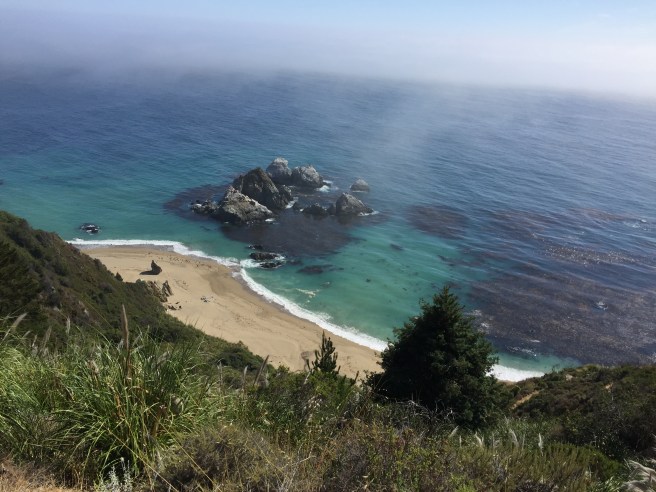
 A deserted coast evokes the 1967 Summer of Love
On the most famous stretch of California’s coast there is hardly a soul in sight, even at the height of the tourist season. The central portion of Big Sur, usually overrun at this time of year, is quiet except for the crashing waves and the occasional hooting seal.
After a series of biblically proportioned natural disasters — fires, floods and mudslides — a 35-mile stretch of California’s Highway One has been largely cut off since February, and is now accessible mainly by foot.
I went to see it for myself, hiking in with my bicycle along a steep trail that goes around a washed-out bridge. When I got to the other side it was like stepping back in time. A languid shuttle bus carries tourists and workers to their destinations, along a road that has almost no traffic. (There is one way to drive in, but the road is so treacherous that few attempt it.)
For cyclists, the open highway feels like a dream. There’s no need for reservations at even the most spectacular restaurants — the dining room at Nepenthe, a Big Sur classic, is only half full on a Saturday evening. For local residents, the steep hike to the outside world is a nuisance, but they’ve got used to it.
The slower pace that’s been imposed here restores one of the attributes that once defined Big Sur — isolation. The craggy coast was where people came to get away, a place that didn’t even have a telephone until 1958. After the second world war it became a magnet for beatniks and Bohemians, and during the 1940s, 50s and 60s Big Sur was at the heart of California’s New-Age movement.
Philosophers and humanists like Alan Watts and Abraham Maslow, who both taught in Big Sur, as well as writers Henry Miller and later Jack Kerouac, fuelled its reputation as a countercultural haven. On the wall at Nepenthe is a photo of Miller drinking at its bar. His move here in 1946 helped put Big Sur on the map. Despite the fact that his novels were banned (or perhaps because of that), Miller’s interests in anarchy, sex, and Buddhism helped set the tone for an entire generation — and his fans flocked to Big Sur to find him.
One of these was the journalist Hunter S Thompson, who worked as a security guard on a local estate. Thompson, alcoholic and erratic, was not a great security guard, but he published his first paid magazine feature during this time.
“If half the stories about Big Sur were true the vibrations of all the orgies would have collapsed the entire Santa Lucia mountain range,” Thompson wrote in the piece, which appeared in Rogue in October 1961. “It’s not likely to happen, however, because almost everything you hear about Big Sur is a rumour, legend or an outright lie.”
Read the rest of the column here.

 Leslie Hook